1Objective
Two commanders, Cerulean and Amber, fight for control of a three-dimensional holographic lattice. You win by capturing the enemy Command Core, by owning most of the lattice, or by cutting the enemy Core off from every source of supply.
- Active Victory. Capture the enemy Command Core. The game ends at once.
- Systemic Victory. Control at least 70% of all cells, which is 180 of 256, at the end of any turn.
- Isolation Victory. Remove or neutralize both enemy Nexuses and seal the enemy Core inside your territory.
Games can also end in a draw or a resignation. See section 13.
2The board
The board is four 8 × 8 grids stacked on top of each other, 256 cells in total. The levels are numbered from the bottom.
| Level | Name | Position |
|---|---|---|
| L1 | Alpha | Bottom |
| L2 | Beta | Home of both Command Cores |
| L3 | Gamma | |
| L4 | Delta | Top |
Files run A–H from left to right and ranks run 1–8 from Cerulean's side to Amber's side. A cell is written as level, file, rank: L3-D5 is Level 3, file D, rank 5.
Adjacency is three-dimensional. Every cell has up to 26 neighbours: 8 around it on its own level, 9 on the level above and 9 on the level below. Cells off the edge of the board simply don't exist. Distances for influence and combat use the largest of the three coordinate differences, so a unit with range 2 reaches a 5 × 5 × 5 cube centred on itself.
3The forces
Each side fields 39 units of five types.
| Unit | Count | Strength | Influence range | Role |
|---|---|---|---|---|
| Command Core | 1 | 1 | 2 | Your king. Lose it and you lose. |
| Nexus | 2 | 1 | 4 | Supply source and the widest aura. |
| Guardian | 8 | 3 | 2 | Heaviest fighter. Holds lines. |
| Striker | 4 | 2 | 3 | Fast raider with long reach. |
| Control Node | 24 | 1 | 1 | The lattice that holds territory. |
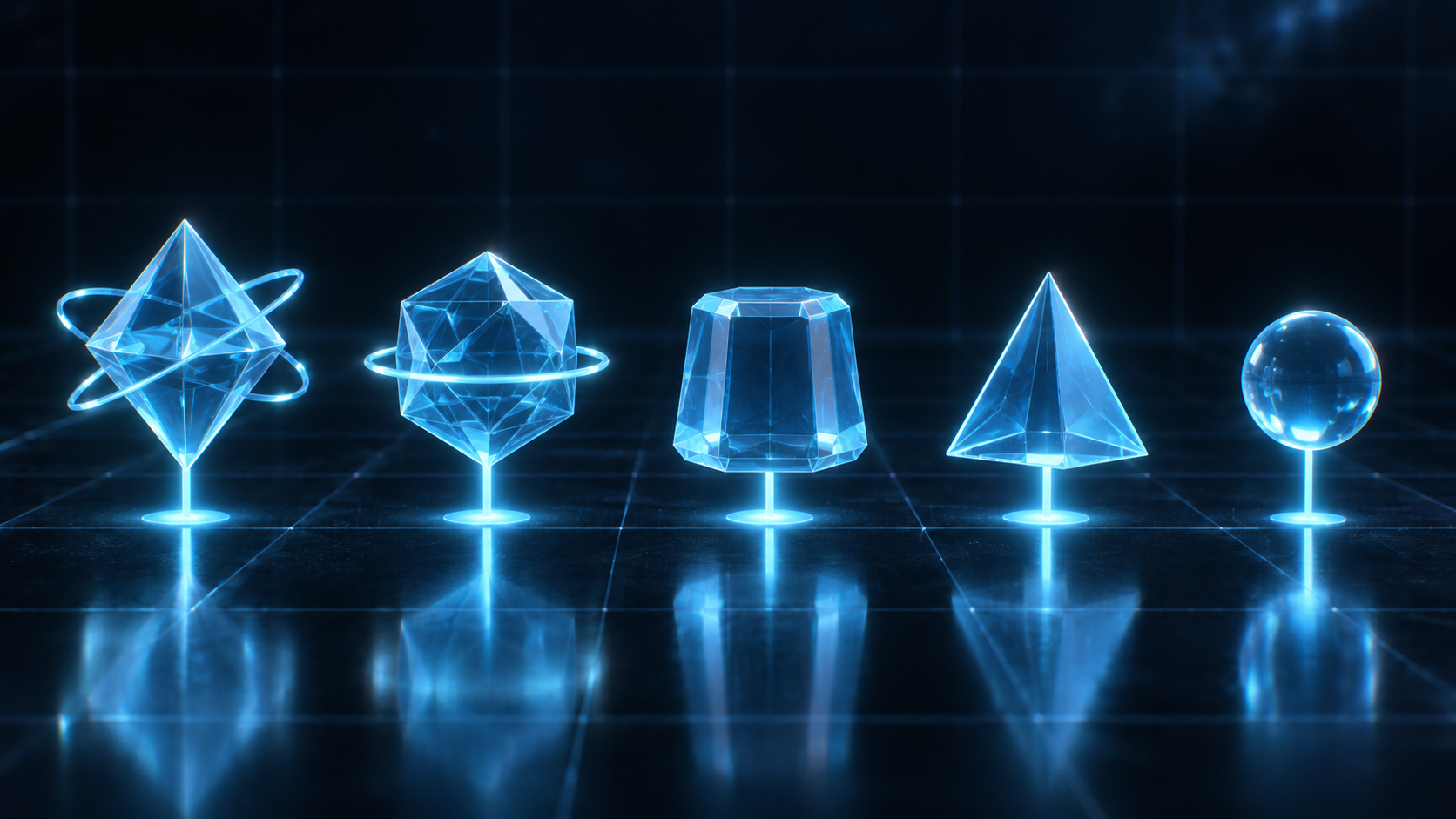
In the 3D game the Core is a ringed octahedron, the Nexus an icosahedron, the Guardian a hexagonal prism, the Striker a pyramid and the Node a sphere.
4Deployment
Cerulean deploys on ranks 1 and 2 of every level. Amber's setup is the same arrangement rotated 180°, on ranks 7 and 8, so Cerulean's D1 becomes Amber's E8.
| Level | Rank 1 (Cerulean) | Rank 2 (Cerulean) |
|---|---|---|
| L1 Alpha | Guardians B1, G1 · Strikers D1, E1 | Nodes B2–G2 |
| L2 Beta | Guardians B1, F1 · Nexuses C1, E1 · Core D1 | Nodes B2–G2 |
| L3 Gamma | Guardians B1, G1 · Strikers D1, E1 | Nodes B2–G2 |
| L4 Delta | Guardians C1, F1 | Nodes B2–G2 |
Amber's Core therefore starts on L2-E8, with Nexuses on L2-D8 and L2-F8. At the opening each side controls exactly half the board.
5Turns and actions
Cerulean moves first. Against a computer opponent you are always Cerulean.
The two-action rule. Every turn you take exactly two actions. The same unit may take both. Each action is one of:
- Move one of your units (section 6). Moving between levels is part of a move.
- Project Influence, a surge on one unit (section 8).
- Hold, which spends one action doing nothing.
End Turn gives up whatever actions you have left. When both actions are spent, the turn ends automatically and the end-of-turn checks run (section 12).
6Movement
A unit always ends its move on an empty cell. Units never share a cell, and there is no capturing by moving onto an enemy. Fighting happens through combat (section 10). Neutralized units cannot move.
Control Node
One step to any of the 8 cells around it on its own level, or one step straight up or straight down. It never moves diagonally between levels.
Guardian
Up to two orthogonal steps. Each step goes north, south, east, west, up or down, so a Guardian may change level mid-move. It never moves diagonally and cannot pass through any unit, friend or foe.
Striker
Up to three steps. Each step may go to any of the 26 neighbouring cells, so Strikers move freely between levels. A Striker may pass through cells held by friendly units but must land on an empty cell. Enemy units block its path completely.
Nexus
One step to any of the 26 neighbouring cells.
Command Core
One step to any of the 26 neighbouring cells, but never into a cell the enemy controls.
7Influence and territory
Every active unit projects an aura: a cube of cells around it whose radius is its influence range, reaching across levels as well. A Nexus with range 4 touches almost half the board.
- Each cell counts how many Cerulean auras and how many Amber auras cover it.
- Opposing influence cancels one for one.
- If one side has more, that side controls the cell. A tie, including zero against zero, leaves it neutral.
Territory is recalculated after every single action. Neutralized units project no influence. On the board, blue cells are Cerulean, amber cells are Amber and dark cells are neutral.
8Influence surge
Project Influence costs one action and gives one of your active units +1 influence range. The boost lasts from the moment you surge until the start of your next turn, so it holds through your opponent's whole turn. A unit that is already surging cannot surge again until the boost expires.
A surge is often the second half of a good turn: move a unit into position, then surge it to flip the cells around it.
9Supply and isolation
Every unit must be able to trace a supply line back to one of its own active Nexuses or its Command Core. The line runs from cell to neighbouring cell in any of the 26 directions, and may only pass through cells that you control or that are occupied by your own units.
- A unit with no supply line is ISOLATED. It pulses yellow and shows a counter.
- At the end of every turn, yours and your opponent's, each isolated unit's counter goes up by one. A unit that is supplied again resets to zero.
- When the counter reaches 3, the unit is permanently NEUTRALIZED. It turns grey, cannot move, projects no influence and gives no combat support. It still occupies its cell and can still be attacked.
Command Cores and Nexuses are supply sources themselves and are never isolated. Being supplied is also worth +1 in combat.
10Combat
Combat happens only when a unit moves. When your unit finishes a move next to one or more enemy units, it engages each of them in turn, strongest base strength first. Retreats and surges never start combat.
Each side's combat strength is:
+ Support adjacent active friendly units, max 3
+ Influence your auras − enemy auras on your own cell, 0 to 3
+ Elevation +1 if you are on a higher level than your opponent
+ Supply +1 if you are supplied
- Higher total wins. The loser must retreat one cell to an empty neighbouring cell that is not enemy-controlled. The game picks the retreat that takes it farthest from the winner, preferring its own territory.
- No legal retreat means capture. The unit is removed from the game. A neutralized unit that loses is always captured.
- Equal totals are a standoff. Both units hold their cells.
- If your moving unit is repelled or captured, it fights no further engagements that action.
The Tactical Log prints every engagement with its breakdown, for example [7] vs [5] (2+2+1+1+1 | 3+1+0+0+1).
11Encirclement
After every move and every surge, every unit on the board is checked. A unit is captured by encirclement when every neighbouring cell that exists is either occupied by an enemy unit or empty and enemy-controlled.
- A single friendly unit next to it, or a single neutral or friendly-controlled empty cell, breaks the ring.
- Off-board cells don't count, so units on edges and corners need fewer enemies to be surrounded.
- Captures can cascade, because each removal changes the map. This chain reaction is called the Litana stratagem, and it resolves automatically.
12End of turn
When a turn ends, these checks run in order:
- Isolation. Isolated units' counters rise. Any that reach 3 are neutralized.
- Systemic Victory. A side controlling 180 or more cells wins.
- Isolation Victory. A side whose opponent has no active Nexus and whose Core is sealed inside hostile territory wins.
- Draw checks. Fivefold repetition and the 500-turn rule (section 13).
- Hand-over. The other side gets two fresh actions. Its surges from the previous turn expire now.
13Victory and draws
| Result | How it happens | When it is checked |
|---|---|---|
| Active Victory | Enemy Command Core captured in combat or by encirclement | Instantly |
| Systemic Victory | You control 180 of 256 cells (70%) | End of any turn |
| Isolation Victory | Enemy has no active Nexus, and every cell around its Core is enemy-occupied or controlled by you | End of any turn |
| Draw by agreement | A draw is proposed and accepted | Any time on your turn |
| Draw by repetition | The same position, with the same side to move, occurs for the fifth time | End of turn |
| Draw by stasis | 500 consecutive turns without any change in territory | End of turn |
| Resignation | A player resigns, the Psychological Forfeit. The opponent wins. | Any time on your turn |
14Opponents and modes
- Two Commanders. Local hotseat. Cerulean and Amber share one screen, and a draw proposal is put to the other player.
- Lt. Cmdr. Data. Plays the Stalemate Doctrine he used against Kolrami: patient, disciplined about supply, engaging only from strength and content to draw. He accepts a draw unless he judges himself clearly ahead.
- Grandmaster Kolrami. Plays for velocity: deep Striker raids toward your Core, tempo over material, contempt for caution. He accepts a draw only when he is clearly losing.
15Controls
| Do this | How |
|---|---|
| Select a unit | Click it. Your unit shows green move markers and its aura. An enemy unit shows its telemetry. |
| Move | Click a green marker |
| Surge | Select your unit, then Project Influence · 1 AP in the Selected Unit panel |
| Hold or end the turn | Hold · 1 AP or End Turn |
| Orbit, zoom, pan | Drag, mouse wheel, right-drag |
| Lift one level out | Press 1–4, the α β γ δ chips or a level tag. 0 or ALL returns. |
| Deselect or close a dialog | Esc |
| Draw, resign, rules | Propose Draw, Resign, Protocols |
16Grandmaster notes
- Pair your actions. Move a unit forward, then surge it. Tournament players call this Action Parity.
- Guard the Nexuses. They are your supply spine and your widest auras. Losing both opens you to an Isolation Victory.
- Attack downhill. Striking from the higher level is a free +1.
- Move in formation. Up to three adjacent friends add +3, more than any single unit's base strength.
- Plan the way home. A Striker deep in enemy territory has three turn-ends to reconnect before it is neutralized.
- Respect the edges. A unit on the rim has fewer neighbours and is far easier to encircle.
QRQuick reference
Each turn
- 2 actions: Move, Surge or Hold
- Same unit may act twice
- End Turn forfeits the rest
Movement
- Node: 1 on level, or straight up/down
- Guardian: 2 orthogonal, no passing
- Striker: 3 any way, through friends
- Nexus, Core: 1 any way. Core never enters enemy space
Strength · Range
- Core 1 · 2 Nexus 1 · 4
- Guardian 3 · 2 Striker 2 · 3
- Node 1 · 1 Surge +1 range
Combat
- Base + Support(≤3) + Influence(≤3) + Higher level(1) + Supplied(1)
- Loser retreats one cell, or is captured
- Tie: standoff
Supply
- Trace to a Nexus or Core through your cells
- Cut off: counter +1 every turn-end
- 3 = neutralized for good
Winning
- Capture the Core
- Own 180 of 256 cells at turn-end
- No enemy Nexus and their Core sealed
- Draw: agreement, 5× repetition, 500 static turns